By Tom Moore
On a brilliant early fall day a couple of weeks ago, I drove south on Highway 101 from Port Townsend to meet with a nonprofit called Brinnon Quilcene Gifts in Kind (GIK). The organization distributes donated goods through a network of local community groups, including food banks, churches, Lions Club, Brinnon School, and Dove House Advocacy Services. Through these partners, essential items such as toothpaste, toilet paper, laundry supplies, adult diapers, socks, and coats reach hundreds of local residents who might otherwise go without.
During my drive, I had time to think about some of the research I had done in preparation for my interview. I had looked up the term “gifts in kind” and learned the word kind originally meant nature, as in related to kin. Thus, to pay or give “in kind” meant to give in the nature of the thing itself, for example, giving actual produce, livestock, labor, or goods, instead of converting the payment into money. The phrase was well established by the 1500s and, of course, continues today.
I then drilled down a bit more on the word “kind.” It is Old English from the word gecynde, meaning natural, innate, or native. In Middle English (11th- 14th Century AD), the meaning expanded to having the natural feelings one ought to have, especially toward one’s own family. Then, from the 1500s on, it took on the modern sense of being gentle, considerate, and benevolent. The underlying idea became about treating someone well, just as you would naturally treat your kin.
With these thoughts in mind, I pulled into Olympic Canal Tracts, a public meeting space just south of the Geoduck Restaurant, to meet with the folks who founded GIK in Brinnon and Quilcene in 2009, as well as those who now run it. The founding members are Candy and Bill Anstiss and Kay and Doug Peterson, who were joined by Ruth and Wes Dunham, and Judi and Mike Hyde. Not able to be with us that day were current members Mary and Jim Kowalczyk.
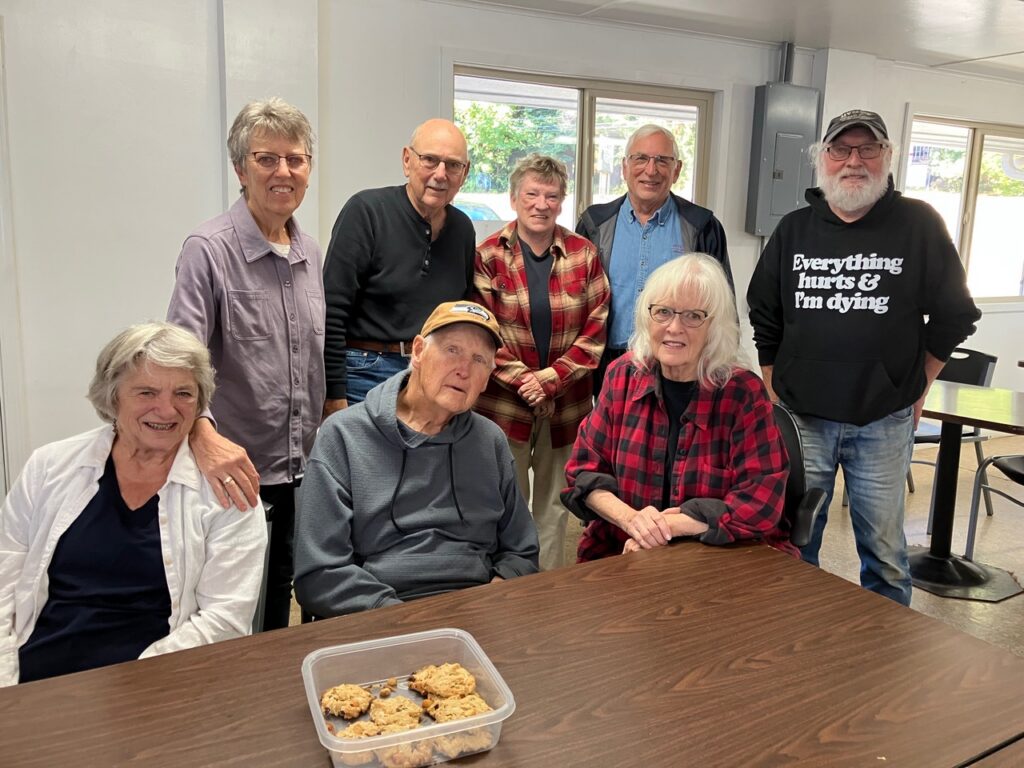
Gifts In Kind Founders
Bottom Row L-R: Candy & Bill Anstiss, Judi Hyde Top L-R: Kay & Doug Peterson, Ruth and Wes Dunham, Mike Hyde
Upon entering the meeting room, I got an immediate feel for the group. I was greeted with a tin of chocolate-coconut-macadania cookies from Judi, and a hearty handshake from her husband Mike, who wore a black hoodie with the line, “Everything hurts & I am dying.” It was a good start and led to a long and lively conversation, with laughter always just a beat away. It is a vibe, I learned, at the core of their mission and success.
The work of GIK all started with an organization called World Vision and a group of volunteers called the Boeing Bluebills. World Vision is a Christian organization known for its international work helping poor communities around the world recover after natural disasters. Another key part of its mission is addressing the needs, particularly of children, in underserved rural communities in the United States. In the early 2000s, World Vision saw a need in Jefferson and Clallam counties and sought out a volunteer group by the name of the Boeing Bluebills to help make that happen.
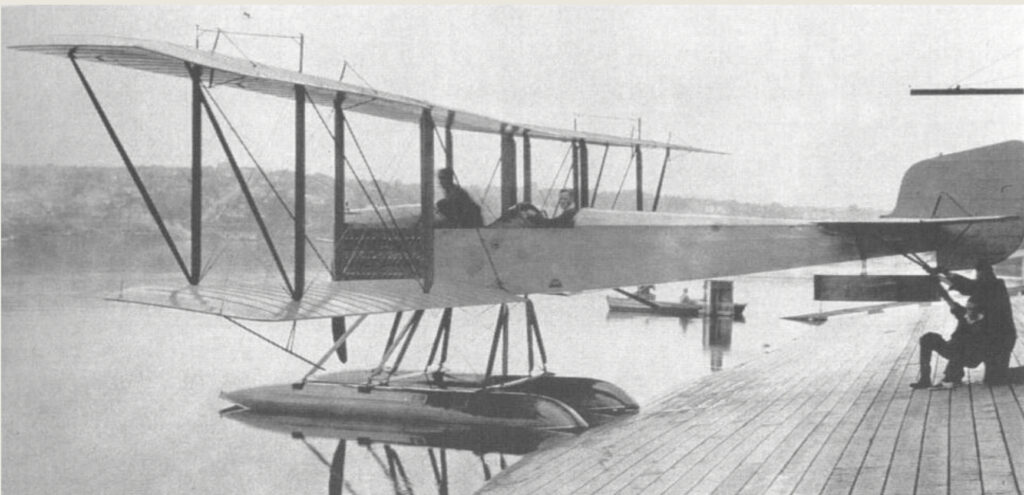
The Bluebills, named after the first plane Boeing ever made, the B&W Model 1, were formed in 1994 and did a wide range of volunteer work in Seattle, South and East King County, and Pierce County. Sponsored by Boeing, they were primarily retirees, their spouses, and employees about to retire. Members came from every part of the company: one co-chair was a former Boeing truck driver turned draftsman, and another chapter leader was a retired manufacturing engineer and Navy veteran. Many were in their late 60s and 70s.
Boeing B&W Model 1 – “Bluebill” Completed in June 1916 at Boeing’s boathouse hangar on Lake Union in Seattle, Washington. It was made of wood, with wire bracing, and covered in linen.
World Vision had a big warehouse in Fife filled with donated items from companies ranging from everyday household items like diapers and soap, to shoes and clothes, to cabinets and appliances. Bluebills living in Port Ludlow and Port Townsend would drive trailers over to the warehouses, fill them up, and come back and give the items to community organizations, which then distributed them to individuals and families in need.
This operation was so successful that the folks in Port Ludlow contacted Bill Antiss – a Bluebill himself – and Doug Peterson, former Boeing employees, to see if they would be interested in bringing these goods and services south to the Brinnon and Quilcene area. They said yes, and with their first project being the repair of the Quilcene Community Center, Gifts in Kind was on its way.
At first, the once-a-month trips to the World Vision warehouse in Fife were done in a pickup truck, but very quickly one pickup became two, and then a rented 18-foot enclosed trailer pulled by a pickup truck was needed to bring back the items available. It was classic good news/bad news. Yes, there were a lot of basic needs filled, but the root causes of those needs are persistent and remain. Candy Anstiss put a fine point on it when she said, “We’ve been here 30 years, and I don’t see it a whole lot different than it was when we first got here. Same challenges as they’ve always been. People need the basics – toothpaste, toothbrushes, shampoo.”
Come 2020, as was the case with so many things in the world, COVID brought on a new set of challenges for GIK. With World Vision refocusing its energies more on pandemic relief worldwide, the everyday items the local population had come to rely on and that World Vision had stockpiled were now in much shorter supply. The rental trailer went away, the pickup was put back into use, and GIK pivoted to writing more grants to get funds from local organizations like the Quilcene Brinnon Garden Club, the Lions Club, and the Emerald Towns Alliance, while also creating partnerships with larger organizations like Costco, Walmart, and the Dollar Store, which have been generous in donating much-needed items.
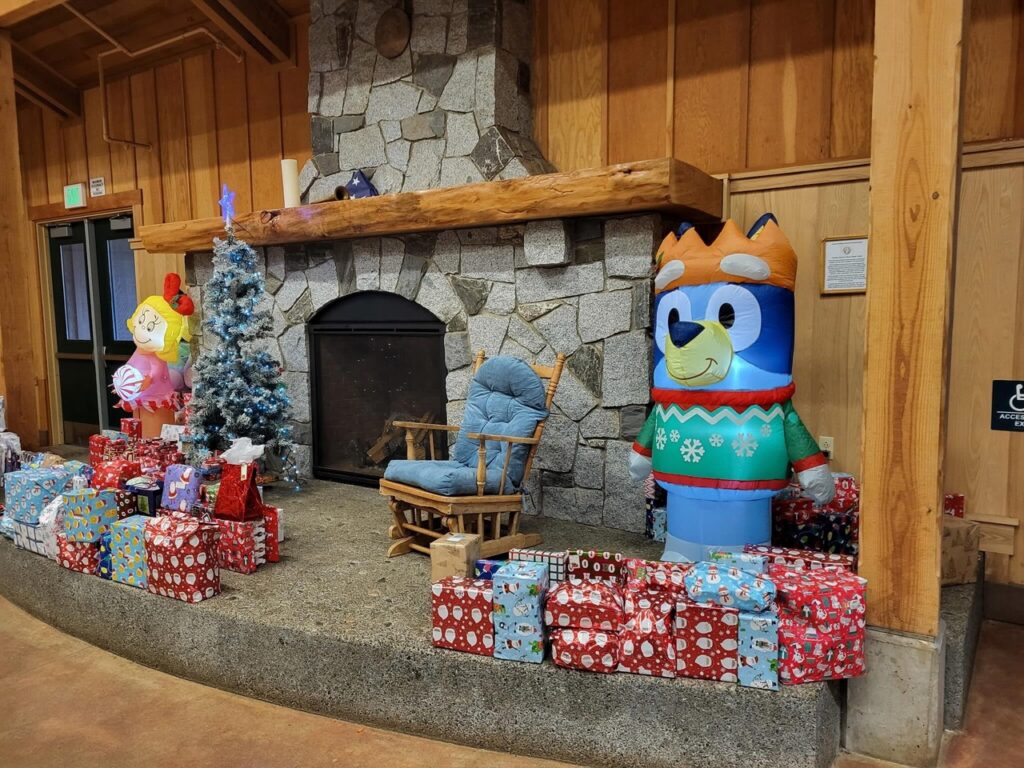
It was more work for GIK, but at the end of the day it brought them closer to the community. In fact, some of the most successful and inspiring fundraising efforts have come from smaller local groups. For example, last Christmas, over 300 kids came to the local Boy Scout camp to receive Christmas presents. The Olympic Peninsula chapter of the Rat Bastards Car Club, which sponsors a car show at the Quilcene Fair & Parade, donated $1,600 for GIK to buy Christmas presents for kids last year.
And a few months ago, Jefferson Community Foundation came to Brinnon for an open house to meet the community and learn more about how they could be of service. It was at this meeting that Judi and Mike and other GIK members met Lisa Palermo, Director of Development at JCF, and let her know a few of their more pressing needs. A little over a month later, JCF had raised close to $10,000 for GIK, which helped fund, among other things, the purchase of two aluminum ramps to be installed in the homes of disabled seniors, as well as the purchase of additional items that are always in short supply: socks, children’s underwear, and supplies for school teachers.
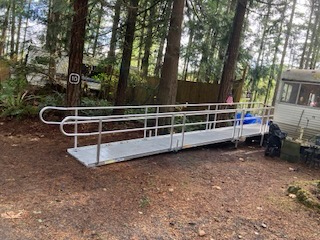
Aluminum ramps are safer and more durable than wooden ones.
Living right alongside these successes are challenges that remain clear: the local population is aging, median household income is significantly lower than Washington State overall, and GIK, and organizations like it, need to work hard to keep up with the need for the day-to-day essentials of living a dignified life: necessary items that all too often are sacrificed in order to pay for rent and food – items like laundry detergent, toothpaste, safety handrails in the bathroom, warm socks and coats in the winter. As Judi says, “You don’t realize how truly limited some of these families are… it can be heartbreaking.”
Christmas gifts every year are a staple of GIK fundraising.
GIK is an all-volunteer organization. Their budget is not very big. There is a Board of Directors, but as far as I could tell, no real hierarchy as to how things are organized – no Presidents or VP’s. At the same time, they’ve been going strong for almost 20 years.
When I asked them how they’ve managed and what their “superpower” is, they responded, almost in unison, “We all like each other!”
Such conviviality is integral to how GIK gets things done. For example, two volunteers in a pickup truck head out early on the morning of their run to the World Vision warehouse in Fife to see what items are available for their distribution partners in the area, that is, the local schools, churches, community centers, etc. Upon their return, products are unpacked and inventoried. At a rotating-hosted potluck dinner, the group reviews what products still need to be sourced before a delivery. The inventory sheets are sent to the distribution organizations, and every effort is made to share what is available as equally as possible. The volunteers meet for lunch after delivery to review the month’s results and to formulate their plans going forward. Judi elaborated a bit on this by adding,
“We feel good about ourselves. The work we do makes us feel better. And when we feel better, I think the work is better. And everybody finds their niche. You know, it’s interesting, sometimes there are all ten of us in that warehouse where we store the items to be distributed, and everybody starts gravitating to what they’re good at, and it all gets done. All in all, it just gives you a warm feeling in your heart because you’re giving back to people.”
As I got into my car to head home, and they all went down to the Geoduck for lunch, I couldn’t help but think these ten people are themselves gifts in kind.
—————————
To find out more about GIK, please email,gikbrinnonquil@gmail.com
Donations can be sent to: Brinnon Quilcene Gifts In Kind, PO Box 216, Brinnon, WA 98320