A Story of Habitat, Restoration and Working in Community
As I was thinking about what the story was going to be for this newsletter edition, I went to JCF’s website looking for ideas, and I started scanning the list of nonprofit organizations it has supported over the last couple of years. It is an impressive list, not just in terms of volume, but in terms of range. JCF is a polymath of philanthropy. From large non-profits to the not-so-big, from organizations dealing with housing and food insecurity to nature-focused organizations, three of which are featured this month.
A through line for JCF is that their work is all interconnected – with the community at large, with the non-profits, and critically, with individuals who want to help, but may not know where to start. JCF is like a Rolodex of connection – where to volunteer, where to learn, where to give.
Are you passionate about immigration Rights? Connect with JICIRA. Unhoused youth? Check out Owl360. The Arts? Go see Key City Theater.
Or maybe you are interested in knowing more about how local organizations are dealing with impacts of climate change, habitat loss, and reversals in laws protecting endangered species? How they are weaving together a network of support and resilience. And that brings us to this month’s story.
I started reading a book a year or so ago by the philosopher-naturalist David Abram. It’s called The Spell of the Sensuous: Perception and Language in a More-Than-Human World. It is a deep read, but I am still slowly traveling through its pages because of his compelling understanding of the relationship between humans and the natural world. The quote that inspired me to write this story is:
“We are only human in contact, and conviviality, with what is not human.”
Conviviality. The word is derived from the Latin convivere, to live together. It may be an old-fashioned word, but in a polarized world such as ours, amidst the multitude of challenges that come with climate change, it seems to me to be very relevant.
For in fact, no organism is solitary. Humans, animals, plants, insects, and microbes exist through relationships. Without them, we humans would face extinction within a few months. The prosperity of a community – human or otherwise – grows from the flow of relationships, not the accumulation of goods.
Run by inspired, dedicated, and extremely convivial individuals, here are three stories about organizations that live in very close contact with nature.
North Olympic Salmon Coalition, Far Reaches Botanical Conservancy, and Discovery Bay Wild Bird Rescue
North Olympic Salmon Coalition
Two of Sarah Doyle’s early passions brought her to Port Townsend and eventually to the North Olympic Salmon Coalition (NOSC) where she is now Executive Director: water and elephants.
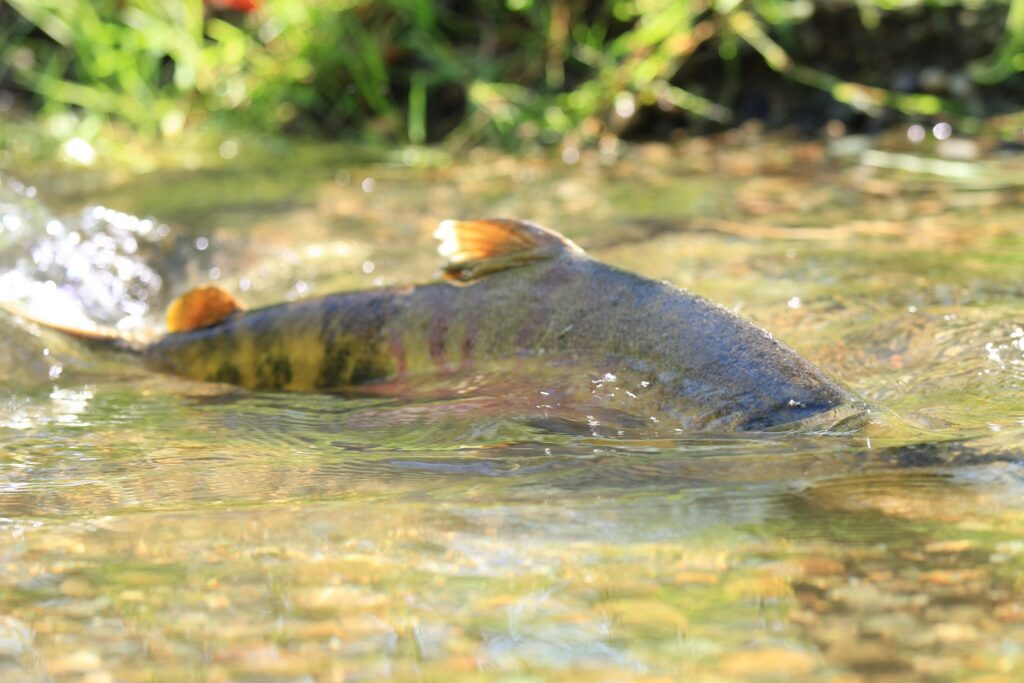
Sarah studied human-wildlife conflict in college and after graduating worked at the Smithsonian Zoo. She then had a series of fellowships in Africa focused on challenges facing elephant populations. The through line in her work with elephants in Africa and now salmon in the Northwest is all about habitat, her love of water, and the creation of healthy places where humans and nature can coexist and thrive.
NOSC is going on its 36th year, and for the past 17 of those, Sarah and her “small but scrappy crew of co-workers” at NOSC have resolutely worked to undo what humans have done over the past century and more to the natural habitat of salmon here in Jefferson County. During this time, they have managed projects big and small – from the volunteer-powered, tree-planting habitat restoration of Chimacum Creek back in the early ’90s to managing the multi-million-dollar 2020 Kilisut Bridge project reconnecting Oak Bay and Kilisut Harbor.
It is hard work. As Sarah explains: “We’re really focused on restoration of habitat. Salmon, like elephants, are incredibly resilient species, but the results don’t come immediately…this work is definitely the long game.” At the same time, experience shows that if they rebuild it, the salmon will come back.
Playing the Long Game
The crux of the problem with Chimacum Creek was that 100 years or so ago the natural course of the creek was changed. It was straightened for better irrigation for local farms. Good for crops, but not so much for summer chum and coho salmon working their way back into the river to spawn and rear. The problem was brought to a head in the 1980’s when the Irondale Road culvert washed out, and the creek’s populations of Summer-run Chum Salmon, an endangered species, were extirpated, i.e., completely wiped out, in the creek.
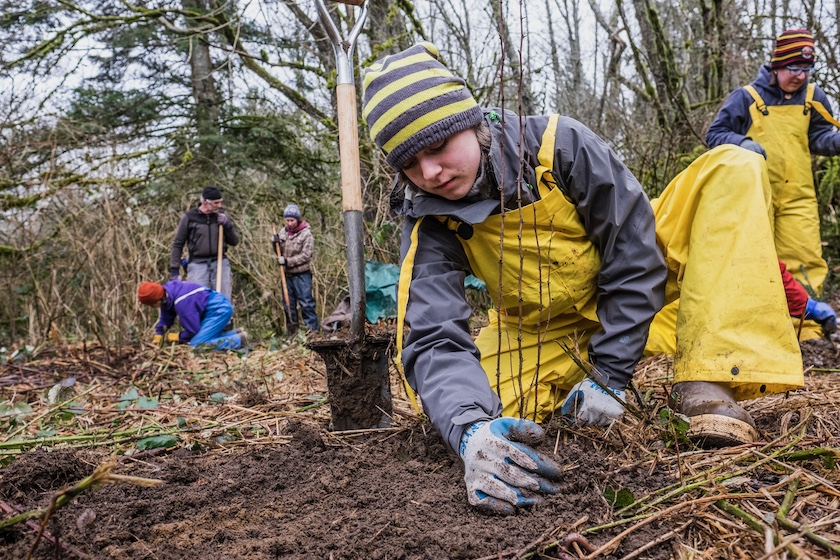
NOSC’s predecessor, Wild Olympic Salmon, was the first on the scene to begin habitat restoration efforts, working with local hatcheries to reintroduce chum to the stream. NOSC took up the mantle in the 90’s to deal with the ongoing complexity that comes with restoration. Chimacum Creek plays a role in many people’s lives and in businesses, farms in particular. NOSC knew it needed to work with those living and working in proximity to the creek, so they partner closely with willing landowners and farmers on the creek to implement habitat restoration projects.
The good news is, the summer chum eventually started to return and continue to return every year. The Chimacum Creek summer chum run is now more robust than it has been for over four decades. However, the long game continues. As the habitat comes back, so do the challenges nature throws back at us. With new trees and eddies, the beavers are back building dams and causing floods to farmland, and the invasive Reed Canary Grass, the Scotch Broom of the waterways, has taken hold. Always working the situation, Sarah believes, “We have new funding that is allowing us to pilot a lot of innovative restoration approaches to continue to mitigate these challenges while also supporting the working lands adjacent to the project.”
The success in Chimacum Creek is a story of many volunteers putting boots on the ground, planting trees and clearing waterways. The story of the Kilisut Bridge is different. It is one of years of planning, millions of dollars from Federal and State funders, and an intensely focused building project during COVID. NOSC designed the project and managed it. They engaged stakeholders – the U.S. Navy, U.S. Fish and Wildlife Service, Washington State Department of Ecology, to name a few. They wrote the grants and got the permits to get the work going. It cost $13,000,000 to build.
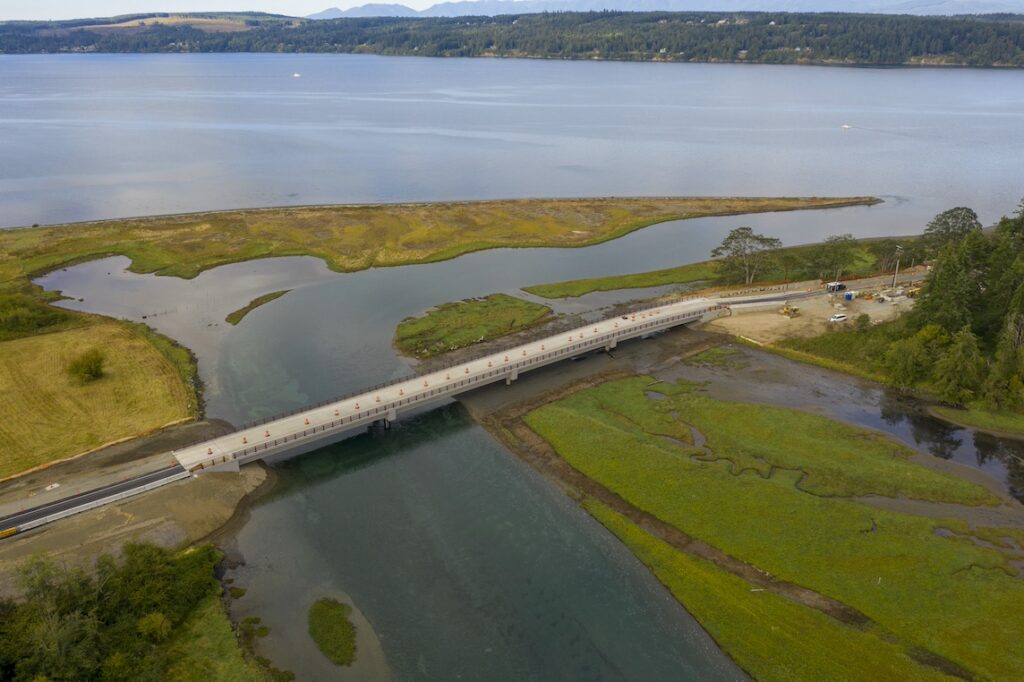
The end goal of the work was relatively clear: mitigate the historically compromised tidal channels and salt marsh between Indian and Marrowstone Islands and reconnect the large numbers of Hood Canal and Puget Sound out-migrating juvenile salmon that converge at Oak Bay with immense foraging opportunities available within Kilisut Harbor. The work by NOSC and its partners was arduous, but in the end a huge success, restoring and enhancing the salmon habitat while also supporting up to 13,500 wintering shorebirds and waterfowl.
A Restoration Economy
What helps to make NOSC so good at what they do is their understanding that partnerships lead to prosperity – for the salmon and for the community at large. They are part of a coalition (it’s right there in its name). One of fourteen Regional Fisheries Enhancement Groups in Washington State dedicated to salmon recovery, they work with the U.S. Fish and Wildlife Service, Washington State, citizen volunteers, landowners, and businesses.Sarah believes their work, “Not only reflects the cultural value of salmon locally, but creates a restoration economy driven by salmon habitat restoration and recovery.”
From a cultural aspect, NOSC works closely with all the indigenous tribes, leveraging their historical expertise of local lands and water and respecting their traditions. On just about every NOSC project, they are in partnership with the tribes. The positive impact on fishing, be it recreational or commercial, enhances what generations have come to love about living in or visiting Jefferson County. Hundreds of thousands of dollars of federal and state money flow into the region every year for restoration projects, providing jobs and helping local businesses like Nordland Construction and Seton Construction.
Working in Community
At the heart of everything NOSC does are the citizen volunteers who provide the thousands of volunteer hours year-round every year that are essential in rebuilding and maintaining a healthy habitat of feeding, resting, and spawning opportunities for salmon. Sarah notes, “ It’s a very rewarding part of the job for us to be so engaged with the community, be it through our education programs or giving them the opportunity to work on the land and in the water and then come back in a decade and see a forest growing and a watershed thriving. It’s pretty cool.”
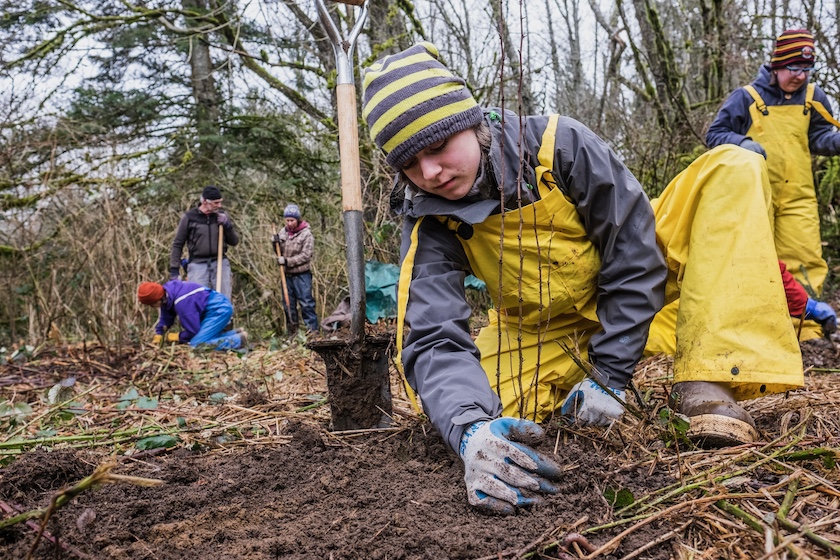
Snow Creek Planting Photo: Charles Espy
Postscript
NOSC values the support of the Jefferson Community Foundation. At the end of our conversation, Sarah told me, “JCF is like a non-profit navigator. Whether it is providing grants, be they from individuals or donor-advised funds, or the workshops they offer to local non-profits. Recently I’ve attended sessions on Board Development and developing workplace policies regarding artificial intelligence. It’s all about connections, and JCF is like the Rolodex of Connections.”
It seems to me that what NOSC is to salmon recovery in the Northwest, JCF is to a healthy community.
If you or someone you know would like to support North Olympic Salmon Coalition, visit their website or contact Jefferson Community Foundation to learn more about the many ways to share your gifts.
Click on the Images Below to Read More…….