¿Cómo podemos ayudarle a sentirse segura?
By Tom Moore
¿Cómo podemos ayudarle a sentirse segura?

Kijan nou ka ede w santi w an sekirite?
How can we help you feel safe?
It’s the question Katie Franco, Libby Palmer, Jim Buckley, and volunteers began asking the immigrant community of Jefferson and Clallam Counties almost 20 years ago.
At the time, Border Patrol agents were picking up people on the streets and taking them to their headquarters in Port Angeles. Sometimes they were released. Often, they were not. They were transferred to the Northwest Detention Center (NWDC) in Tacoma, a privately run, for-profit prison. Local Port Townsend residents and activists responded to that breach of the community in 2007, and with it, the seeds of what would become Jefferson County Immigrant Rights Advocates (JCIRA) were sown.
They are still asking the same question today.
Since becoming a nonprofit organization in 2017, JCIRA has helped immigrants in Jefferson County from 19 countries navigate the challenges of coming to a new country, and while the desire to feel “safe” is universal, it is at the same time very personal; unique to each individual. There are basic needs for food and shelter, work, education, and healthcare. But then there is the more existential need to feel safe in one’s home; safe from losing one’s rights; rights laid out clearly in the Fourth Amendment of the US Constitution, where it states everyone has the right “to be secure in their persons, houses, papers, and effects, against unreasonable searches and seizures.”
Natalia Durán, JCIRA Outreach Coordinator, believes she and her staff need to not only ask how they can keep people safe, but to go one step further and become advocates for those who cannot advocate for themselves. She says, “For those most at risk in our community, for those being profiled and persecuted because of their race, we need to educate them about their rights. When you educate, you empower.”
JCIRA could not do this work without the support of Jefferson Community Foundation’s Fund for Women and Girls. Established by Debbi Steele in 2009 with the goal of changing lives so women and girls can be safe, secure, equal, and empowered, the Fund now has an endowment of $500,000.
In 2025, through The Fund for Women & Girls, JCF awarded JCIRA a three-year sustaining grant of $75,000 to establish a Legal Support Fund providing services ranging from naturalization applications, citizenship test preparations, family immigration petitions, asylum, and referrals for clients who have experienced domestic violence or other crimes.
The grant also provides for free mental health counseling as well as participation in Women’s Justice Circles Projects, a program offered by the Seattle-based Inter-community Peace & Justice Center. The goal of the JCIRA Women’s Justice Circle is to bring voices of immigrant women and families living on the margins who are not typically included in organizing for change into conversation around what their needs are and how to best meet them.
As Siobhan Canty, CEO of JCF, says, “When facing a crisis, the best possible thing to do is to engage in your local community and help build the connectivity and the resources needed to be resilient when the moment for action comes.”
For too many in our community, that moment is now. Here are some stories of individuals helped recently by JCIRA. To keep them safe, I have not used their names.
A young mother from Mexico with two children was unable to find legal representation to pursue her asylum case. JCIRA supported her family for over a year. We found her legal representation, provided financial support to pay for legal documents that had to be filed, and had bilingual volunteers accompany her to Immigration Court in Seattle.
Two young Venezuelan families with little children were here on TPS status, homeless and living in their car outside of Port Townsend. With money from JCIRA’s Family Fund, they were able to stay in a hotel room for a few nights while we helped them find more stable housing, work opportunities, as well as helping to get the children registered in school.
After arriving in the United States, we helped a teenage girl from Guatemala access the mental health support she needed to deal with the shock of being in a new country without her family. She now has a therapist who has done social work in Guatemala, speaks Spanish, and most critically, understands her culturally.
Challenging stories like these abound. The good news, however, is that Natalia, her co-workers, and a diverse group of volunteers are listening. Two recent programs come to mind. One was a survey JCIRA developed with Jefferson Healthcare to better assess the needs of the immigrant community. Was access to care a problem? What happens if one doesn’t speak Spanish? We know diabetes is a big problem: how can we provide better treatment?
A new program, currently in its startup phase, is an effort to solicit stories from immigrants who work in the community, but who are frequently unacknowledged – farm laborers , housekeepers, cleaners, and landscapers. JCIRA wants to ask them to tell their stories of how and why they came here, and how they are feeling now.
While Natalia is excited about these programs, she knows there is much more work to do. But, as she says, “To be part of a successful non-profit like JCIRA is inspiring. It means there are problems, yes, but it is even more beautiful because of the response of the community – other human beings – making this happen. It’s like they are saying: “Eres bienvenido aquí.”
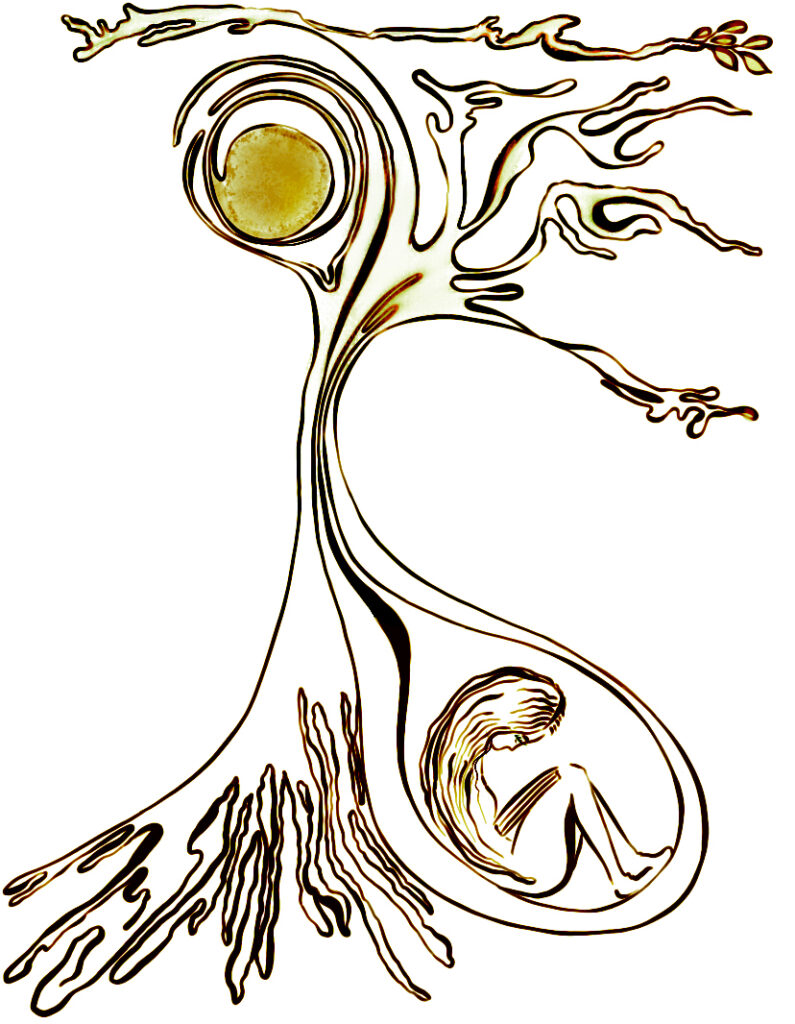
The image below was drawn by Hispanic member of Jefferson County who asked not to be identified due to concerns for her safety, and the safety of their family. They told me the following story: There was a protest last year in Olympia that I wanted to go to. It was in support of greater healthcare access for immigrants and the rights of domestic workers. People told me not to go. They told me it was very risky because of my immigration status. So I had to stay home. I felt impotent. Powerless. Unable to see the light of day. Because I felt this way, I drew this picture of me.
If you know someone who is at risk of being illegally detained, call JCIRA’s Rapid Response Team at 360-531-2958.
For more information on JCIRA and the services it provides go to https://www.jcira.org/
To donate to Jefferson Community Foundation, go to www.JCFgives.org