A Message from JCF Board Chair Kate Roosevelt
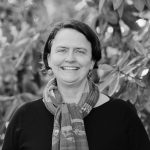
Kate is the co-president of Campbell & Company, a highly respected national fundraising consulting firm. She also serves the Board of Directors of The Giving Institute, a national effort dedicated to empowering generosity. And she regularly presents on topics about nonprofits and charitable giving at regional and national conferences.
Trust is the most valuable currency in the work we all collectively do as donors, volunteers, friends, neighbors, and advocates across Jefferson County. Through my work as a national fundraising strategist, I also see trust as a currency that is at risk and in decline, especially in the social sector where I’ve focused my time and energy for the past thirty years.
Recently, I went to the internet and asked a robot, “what is trust?” And here’s what I learned. Trust – is the firm confidence in the reliability, truth, ability, or strength of someone or something. It involves placing oneself in a position of vulnerability, believing in another’s positive intentions, and expecting consistent, responsible action, especially in situations with high uncertainty. Trust falls, right? Aha, I thought to myself, now we’re getting somewhere, trust is a practice! And it is the foundation of relationships and functional systems across our society.
Why do I care so much about trust?
- I am passionate about the sector of our society that is first and foremost designed to help people live their best lives and protect the natural world that sustains those lives – we call this the nonprofit sector, the charitable sector, the social sector, the third sector. I gravitate to social sector as it really speaks to the meaning and purpose of the sector. And it is the act of giving and receiving and co-creating solutions to intractable problems that again requires a high degree of trust.
- In the course of any given year, the consulting firm where I work has the honor and privilege of partnering with hundreds of organizations – groups that produce theater, mount exhibitions in museums, educate people, ensure that our forests are healthy and accessible, help people who are sick get healthy again, feed and house people, and so much more.
- The people leading these organizations are nothing short of heroic, they are committed, they are creative – and they need us to trust them – trust that they know their work best, trust that they know where the solutions lie, and trust that the resources that are shared with them will be put to good use (even if they stumble every now and then)
- I believe community foundations like JCF have a unique and powerful role to play in creating and harnessing the power of trust. We can and do serve as an honest broker, bringing people, ideas, and resources together to facilitate real, positive, and sustained change in places like Jefferson County
I’m a bit worried these days about that state of trust across our country, across the globe, and even here at home in Jefferson County. We hear that trust in institutions is declining. We don’t know what news sources to trust. We don’t even know if we can trust science. Science?!? Just this week, I received a special report from the Giving USA Foundation, Donor Confidence and Giving Behavior: A 2026 Report, that points to a “trust gap” among nondonors who are unsure whether charities are doing a good job. And given that giving is a learned behavior, this lack of trust is preventing many people from becoming givers to begin with.
A few other headlines from this report:
- One in four donors indicate they plan to give less in 2026 – and that is up from 16% in 2025
- Despite improvements in their personal financial situations, the primary driver of their concern is the broader economy
- A notable exception: Those who attend religious services weekly report higher financial stress, yet they plan to increase their giving this year
- The methods for giving continue to evolve at a rapid pace: direct mail remains effective across generations (and especially with Generation Z), however the journey from a direct mail appeal to a completed gift increasingly runs through digital channels. This could be attributed to the “mailbox advantage” as email inboxes overflow daily. Donors are now twice as likely to give online in response to a direct mail piece than to mail back a form. Nevertheless, the online giving experience is frustrating for some donors with 20% of donors abandoning online donations before completing the transaction.
- The number one factor prompting online giving is being asked in person. Bottom line, communicating and asking in multiple forms is advisable. Personal relationships matter, and online platforms make giving easy.
- Some changes to federal tax policy show promise. Take, for example, the Universal Charitable Deduction, which offers benefits to millions of standard deduction tax filers. (Following the passage of the Tax Cuts and Jobs Act in 2017, the percentage of Americans who itemize fell from 40% to 8%, and it is believed that this shift resulted in a drop in giving of $20B in 2018 alone, and $17B in subsequent years.) It is now a permanent part of the tax code. However, 75% of donors report they are unaware of this provision.
- When people learn about the UCD, 13% of current donors say they will increase their giving and 33% of nondonors say they will begin giving. This presents an incredible communication opportunity for nonprofits that could help slow, if not reverse, the trend of fewer households giving.
All of this leads me not to despair but to action – to change the narrative to one where we celebrate the fact that, with few exceptions, our nonprofit sector is working exactly as intended – community informed and led, community supported, and always willing to adapt and change – and rooted in trust. That there is power in collective action and generosity as a means for solving problems that the governments and even businesses have failed to solve, let alone address. That is rooted in trust. And most of all, that giving/volunteering helps us make meaning in our lives – and helps us to build and sustain community. This is the place where trust lives, is practiced, and is sustained.
We are all so lucky to be here, in the place we love, with people we love, committed to building a future of opportunity for all in Jefferson County. Your community foundation, JCF, is here for the long haul ready to listen, ready to engage, ready to convene, ready to advise, ready to comfort. We do not take your trust for granted and we simply can’t do this work without you. We are better together, and our impact is greater together. Thank you.